Arewa Art
Calabash, henna, and calligraphy in Arewa together represent a deeply rooted yet evolving artistic ecosystem where utility, identity, and expression converge. From the carved surfaces of calabashes that embody history and sustainable design, to the intricate, symbolic patterns of henna applied as living art, and the disciplined elegance of calligraphy that transforms language into visual form, these traditions reflect a sophisticated cultural intelligence. Despite their richness, they remain under-recognized in global art discourse. Elevating them requires not preservation alone, but strategic positioning within contemporary markets, where their authenticity, craftsmanship, and narrative depth can command rightful global attention.
Why a Humble Arewa Calabash Deserves a Global Stage
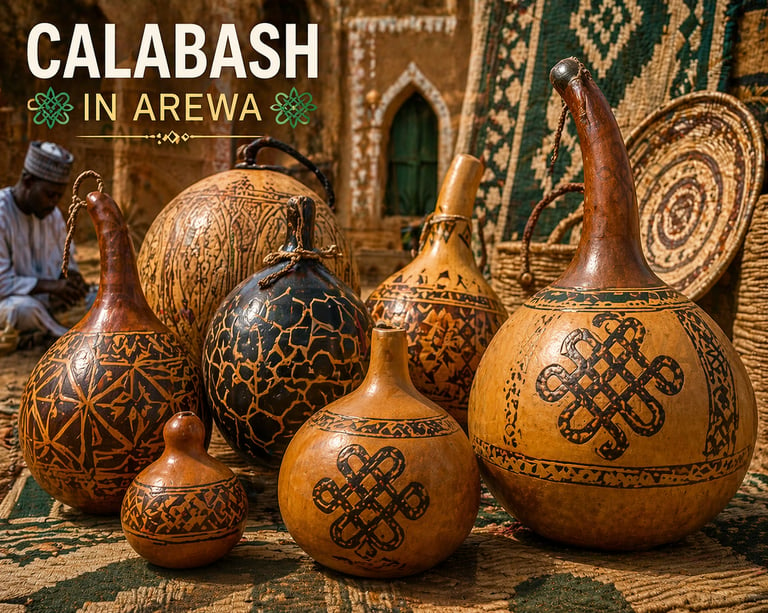
In an era where global design is increasingly searching for authenticity, sustainability, and cultural depth, one of Africa’s most understated artistic traditions remains largely overlooked: the calabash craft of Northern Nigeria, known as Arewa.
The calabash, fashioned from the dried shell of the gourd, may appear modest at first glance. Yet, to dismiss it as a simple household object is to misunderstand its profound cultural, artistic, and economic significance. In Arewa, the calabash is not merely used; it is lived. It carries water, serves food, marks ceremonies, and, perhaps most importantly, tells stories.
Historically, calabashes have been central to everyday life across cities such as Kano and Sokoto, where trade, agriculture, and craftsmanship have long intersected. Before the proliferation of industrial materials, the calabash was indispensable. But its importance did not end with utility. Over centuries, artisans transformed it into a canvas,engraving, burning, and decorating its surface with intricate patterns that reflect both local identity and broader Islamic artistic influences.
These patterns are not arbitrary. They embody a disciplined visual language: geometric precision, repetition, and symbolism. In many ways, Arewa calabash art parallels global traditions of sacred and decorative design, from Moroccan zellige to Persian arabesques. Yet, unlike these globally recognized forms, the calabash remains largely absent from international discourse on design and material culture.
This omission is not merely an oversight; it is a missed opportunity.
At a time when sustainability has become a central concern in global production, the calabash offers a compelling alternative. It is organic, biodegradable, and locally sourced. Its production requires minimal industrial input, relying instead on skill, time, and cultural knowledge. In a world saturated with synthetic materials, the calabash represents a return to ecological intelligence, an approach that modern design urgently needs.
Beyond sustainability, there is the question of artistic value. Contemporary designers and collectors are increasingly drawn to objects that combine function with narrative. The Arewa calabash does precisely this. Each engraved line, each polished surface, carries the imprint of a maker and a tradition. It is not mass-produced; it is authored.
And yet, despite this richness, calabash artisans often operate at the margins of the global art economy. Their works are sold in local markets, sometimes for prices that fail to reflect the labour and cultural capital embedded in them. Even in major urban centres like Abuja, where the contemporary art scene is expanding, calabash art is still rarely positioned as a collectible medium alongside painting or sculpture.
This raises a broader question about how the global art world defines value. Why are certain materials, canvas, bronze, marble, automatically granted legitimacy, while others, like the calabash, are confined to the category of “craft”? The distinction is increasingly outdated. Across the world, the boundaries between art, craft, and design are collapsing. If Japanese ceramics and Scandinavian woodwork can achieve global recognition, there is no inherent reason why Arewa calabash should not.
The challenge, therefore, is not one of quality but of visibility and framing. Calabash art must be curated, documented, and presented within contemporary contexts, galleries, biennales, and international fairs. It must be written about, theorized, and integrated into broader conversations about African art and global design.
There are early signs of this shift. Designers are beginning to incorporate calabash elements into lighting, furniture, and fashion accessories. Cultural entrepreneurs are exploring new markets, including digital platforms. But these efforts remain fragmented. What is needed is a more deliberate strategy, one that connects artisans to institutions, markets, and audiences beyond their immediate environment.
Equally important is the role of policy and investment. Cultural industries are now recognized as drivers of economic growth, particularly in emerging economies. Supporting calabash production is not simply a matter of heritage preservation; it is an economic imperative. With the right infrastructure, training, financing, branding, this sector could generate employment, especially for rural communities, while positioning Nigeria as a leader in sustainable design.
Ultimately, the story of the Arewa calabash is about more than an object. It is about how societies value their own knowledge systems in a globalized world. It is about whether tradition is seen as a relic of the past or as a resource for the future.
The calabash has endured for centuries because it is both practical and symbolic, both simple and sophisticated. The question now is whether the world is ready to see it for what it truly is: not just a vessel, but a work of art.
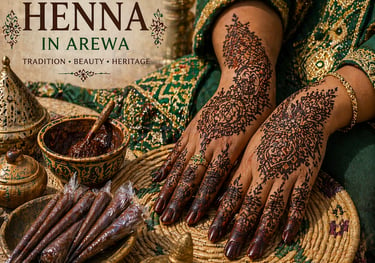
Arewa Henna A Living Art the World Has Yet to Fully Recognize
In the global conversation on beauty, identity, and artistic expression, few traditions embody all three as seamlessly as henna in Northern Nigeria, Arewa. Yet, despite its depth, sophistication, and cultural significance, this art form remains largely underrepresented in international discourse.
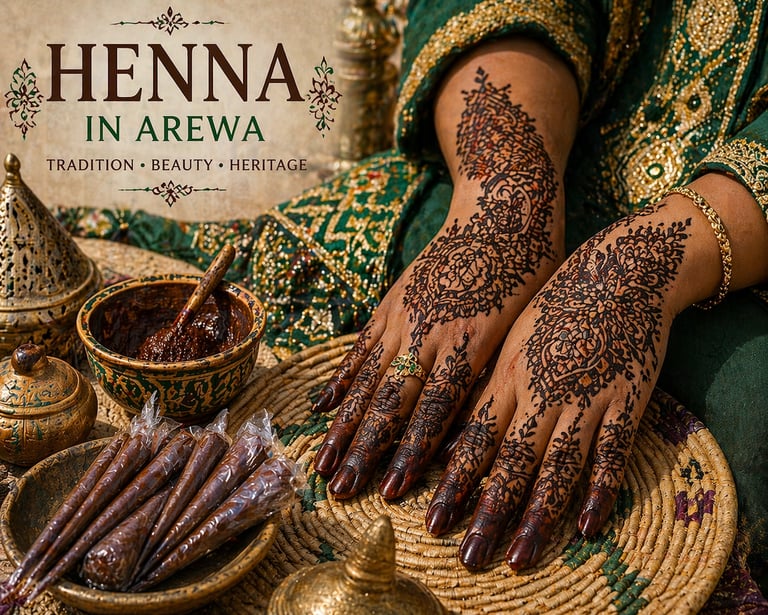
Henna in Arewa is not simply decoration. It is a language. It marks transitions, encodes identity, and transforms the human body into a living canvas. In a time when global fashion and beauty industries increasingly borrow from indigenous traditions, it is worth asking why this centuries-old art has not been accorded the recognition it deserves.
Historically, henna, derived from the leaves of the Lawsonia inermis plant, has been integral to social and spiritual life across Northern Nigeria. In cities such as Kano and Zaria, its application is inseparable from rites of passage. Weddings, naming ceremonies, and religious celebrations are incomplete without the intricate adornment of hands and feet.
But beyond ceremony, henna carries layered meanings. The patterns are deliberate. Floral motifs suggest beauty and growth. Geometric arrangements reflect order and discipline. More elaborate designs often signal status, occasion, or regional identity. In this sense, henna operates much like textile traditions or architecture, it communicates without words.
The artistic discipline behind Arewa henna is often underestimated. Precision, symmetry, and control are essential. Unlike painting on canvas, henna allows no easy correction. Each line is permanent, at least temporarily, demanding both technical mastery and creative intuition. The artist must work with the contours of the body, adapting design to form. It is a practice that sits at the intersection of fine art, design, and performance.
Yet, globally, henna is often reduced to a casual or recreational activity, festival adornment or temporary tattoo, stripped of its cultural depth. This reduction overlooks the sophistication of traditions in places like Arewa, where the art has been refined over generations. It also obscures the intellectual and aesthetic systems embedded in the designs themselves.
There is, however, a compelling argument for why henna from Arewa should command greater global attention, particularly at this moment.
First, it aligns with the growing demand for natural and sustainable beauty practices. In contrast to synthetic cosmetics, traditional henna is organic, biodegradable, and safe when properly prepared. As consumers worldwide seek alternatives to chemical-heavy products, henna offers not just a solution, but a culturally rich one.
Second, henna challenges conventional definitions of art. It is ephemeral, existing for days or weeks before fading. Yet, its impermanence does not diminish its value. On the contrary, it situates henna within a broader category of temporal art, alongside performance, body art, and even certain forms of contemporary installation. The body becomes both medium and exhibition space.
Third, henna holds untapped economic potential. Across Northern Nigeria, thousands of women are engaged in this craft, often informally. In urban centres like Abuja, henna artists are already adapting their work for modern clients, bridal industries, fashion events, and digital promotion. With structured support, this could evolve into a significant creative industry, generating income while preserving cultural heritage.
The challenge, however, lies in recognition and positioning. As with many indigenous art forms, henna is frequently categorized as “craft” or “cosmetic service,” rather than as a legitimate artistic discipline. This classification limits its visibility in galleries, academic discourse, and global markets.
What is needed is a reframing. Henna must be documented, curated, and critically engaged with. Its practitioners should be recognized not merely as service providers, but as artists. Its motifs should be studied not just for their aesthetic appeal, but for their cultural and symbolic meanings.
There are precedents for this shift. Across the world, forms once considered peripheral, tattooing, textile weaving, even culinary arts, have entered mainstream artistic and cultural recognition. Henna in Arewa is equally deserving of this elevation.
Ultimately, the question is not whether henna has value. That is already evident in its enduring presence across generations. The question is whether global audiences are willing to see beyond surface beauty to the deeper narratives it carries.
In Arewa, henna is more than ornament. It is memory, identity, and artistry applied by hand. And in a world searching for meaning in its aesthetic choices, it offers something rare: beauty that is both personal and profoundly cultural.
Calligraphy in Arewa: The Quiet Power of Ink in a Visual World
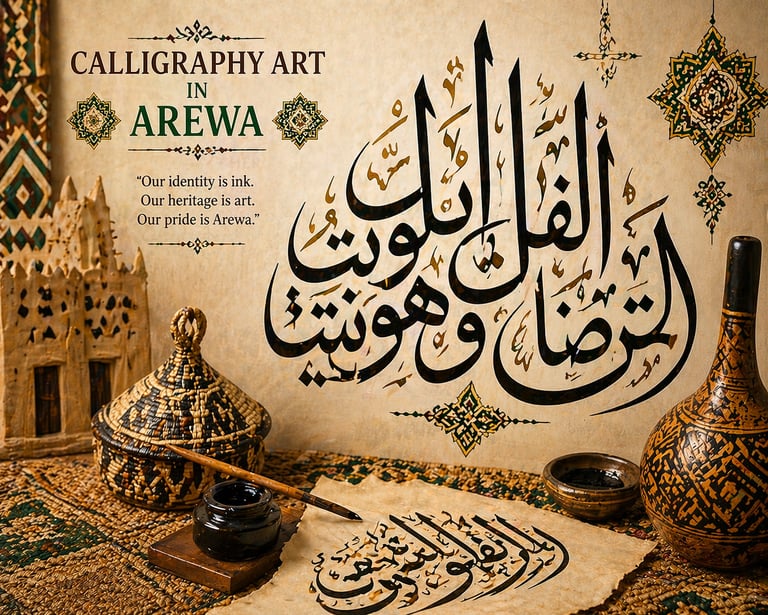
In a global art market increasingly dominated by spectacle, scale, and digital experimentation, there exists a quieter, more disciplined tradition whose significance is often underestimated: calligraphy in Northern Nigeria, Arewa. It is an art of restraint, precision, and meaning. And yet, despite its intellectual and aesthetic depth, it remains largely peripheral to international conversations about contemporary art.
Calligraphy in Arewa is not merely about writing beautifully. It is about transforming language into form, and form into meaning. Rooted in the long history of Islamic scholarship and literacy across the region, the practice evolved alongside centres of learning in cities such as Kano and Sokoto. For centuries, scholars, scribes, and artisans have used ink not just to record knowledge, but to elevate it, giving visual expression to texts that carry spiritual, philosophical, and cultural weight.
This tradition is anchored in Arabic script, but it is not confined to it. Over time, calligraphy in Arewa has absorbed local sensibilities, rhythms, patterns, and spatial arrangements that reflect the broader aesthetic environment of Northern Nigeria. The result is a distinctive visual language: bold yet controlled, expressive yet disciplined. Each stroke is intentional. Each composition is balanced.
Unlike many contemporary art forms that prioritize individual expression above all else, calligraphy demands submission to structure. There are rules—proportions, angles, relationships between letters—that must be mastered before innovation can occur. It is this tension between discipline and creativity that gives the art its enduring strength. The calligrapher is both technician and artist, working within a framework that has been refined over centuries.
Yet, in today’s global context, such discipline is often overlooked. The art world tends to privilege novelty over continuity, disruption over refinement. As a result, traditions like Arewa calligraphy are frequently categorized as heritage practices rather than living, evolving art forms. This classification is misleading.
Calligraphy is not static. Across Northern Nigeria, a new generation of artists is reinterpreting the tradition, integrating it into painting, sculpture, digital design, and even architecture. In urban centres like Abuja, calligraphy is appearing in galleries, branding, and public art. It is being adapted for contemporary audiences without losing its core principles. This is not preservation; it is evolution.
There is also a broader relevance that extends beyond aesthetics. In an age defined by speed and fragmentation, calligraphy offers a counterpoint. It demands patience. It rewards focus. It reintroduces the idea that creation is a process, not an instant output. For younger generations, particularly in rapidly urbanizing societies, this has both cultural and educational value.
Moreover, calligraphy occupies a unique position at the intersection of art and literacy. It reminds us that writing itself can be an artistic act—that language is not only a tool for communication but also a medium for beauty. This perspective is increasingly rare in a world where text is often reduced to function, stripped of form.
The economic dimension should not be ignored either. As global interest in culturally grounded design continues to grow, Arewa calligraphy holds significant potential. It can be integrated into fashion, product design, interior decoration, and digital media. It can travel, across borders and industries, without losing its identity. But this requires intentional positioning. Without it, the art risks remaining localized, undervalued, and under-documented.
The challenge, therefore, is not one of relevance but of recognition. Calligraphy in Arewa must be brought into the global conversation—not as a relic of the past, but as a contemporary practice with intellectual rigor and aesthetic power. It must be curated, studied, and collected. Its practitioners must be acknowledged as artists, not merely custodians of tradition.
Ultimately, calligraphy in Arewa represents something that the modern world is in danger of losing: the ability to slow down, to refine, and to find meaning in form. It is an art that does not shout, but endures. And in that endurance lies its quiet power.
In the end, ink—applied with care, guided by knowledge, and shaped by culture—can say more than words alone ever could.
Arewa Life
Across Northern Nigeria, commonly referred to as Arewa, traditional life unfolds as a deeply rooted system of values, aesthetics, and social organization shaped over centuries. It is not merely a way of living but a coherent cultural philosophy anchored in community, faith, craftsmanship, and continuity. In an era of rapid modernization, Arewa’s traditional life remains a powerful expression of identity and resilience.
At the heart of Arewa culture lies a strong communal structure. Society is organized around extended families, kinship networks, and traditional institutions led by emirs, district heads, and village leaders. These structures are not symbolic; they actively guide governance, conflict resolution, and social cohesion. Respect for elders, hierarchy, and collective responsibility define everyday interactions, reinforcing a sense of belonging and mutual accountability.
Religion plays a central role in shaping both public and private life. Islam, which has been deeply embedded in the region for centuries, influences daily routines, moral codes, and social conduct. From early morning prayers to communal gatherings during religious festivals such as Eid, spirituality is interwoven with daily existence. This religious grounding fosters discipline, modesty, and a shared ethical framework across communities.
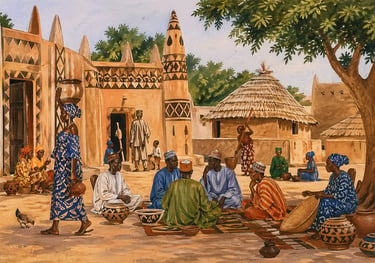
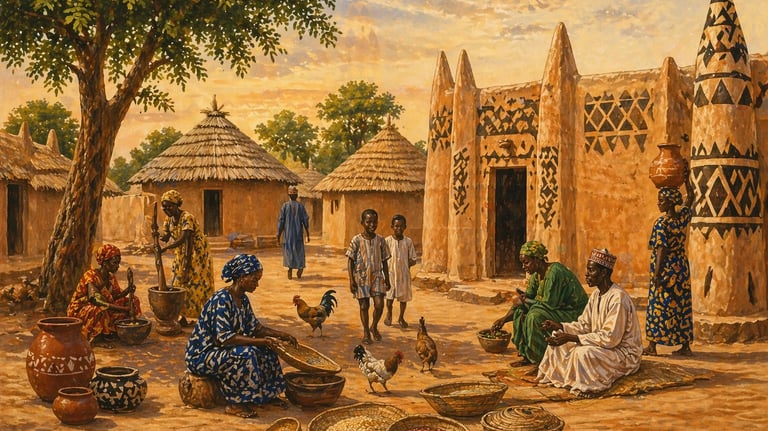
Traditional architecture in Arewa reflects both environmental adaptation and artistic expression. Mud houses, often adorned with intricate geometric motifs, stand as functional and aesthetic achievements. These structures are designed to regulate temperature in the harsh Sahel climate while simultaneously serving as canvases for cultural symbolism. The famous Hausa architectural style, with its domes and decorative reliefs, demonstrates a sophisticated understanding of design long before modern engineering systems.
Economic life is equally rooted in tradition. Agriculture remains a primary occupation, with crops such as millet, sorghum, and groundnuts forming the backbone of rural livelihoods. Alongside farming, artisanal crafts flourish—leatherwork, weaving, pottery, calabash decoration, and metalwork are not only sources of income but also vehicles of cultural transmission. Markets, vibrant and dynamic, function as both economic hubs and social spaces where relationships are built and sustained.
Artistic expression in Arewa is subtle yet profound. Unlike overtly commercialized art forms, Arewa art is embedded in daily life—seen in the patterns of textiles, the engravings on calabashes, the elegance of calligraphy, and the symbolism in henna designs. These art forms are deeply functional, often tied to rites of passage, marriage ceremonies, and social status. They tell stories, preserve memory, and communicate identity without the need for formal galleries.
Cultural practices and ceremonies further illustrate the richness of Arewa life. Weddings, naming ceremonies, and festivals are elaborate affairs marked by music, dance, attire, and food. Traditional garments such as the baban riga and zani are not merely clothing but statements of heritage and dignity. Music, often accompanied by instruments like the talking drum and kakaki, reinforces oral traditions and historical narratives.
Importantly, Arewa traditional life is not static. It evolves, adapting to contemporary realities while retaining its core values. Urbanization, education, and technology are reshaping aspects of daily life, yet the underlying cultural framework remains intact. This ability to balance continuity and change is perhaps the greatest strength of Arewa culture.
In essence, Arewa is a living tapestry where tradition is not preserved in isolation but actively practiced and reinterpreted. Its cultural systems offer valuable lessons in community cohesion, sustainability, and identity. As global attention increasingly turns toward indigenous knowledge systems, Arewa stands as a compelling example of how tradition can remain relevant, dynamic, and profoundly meaningful in the modern world.
Village Life in Arewa: Simplicity, Structure, and Shared Living
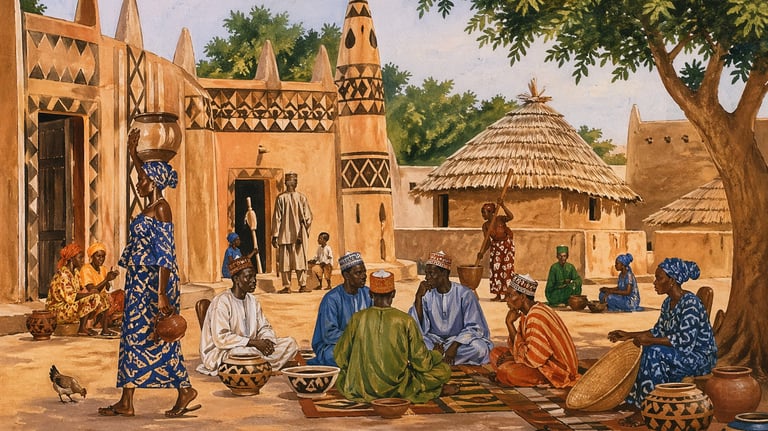
Village life in Arewa is defined by rhythm, community, and a deep connection to land and tradition. It is a way of life where time follows natural cycles—sunrise marks the beginning of work, and sunset signals rest. Unlike urban environments, life in the village is not hurried; it is deliberate, structured, and anchored in collective existence.
The day typically begins early. Men head to farms or tend to livestock, while women manage household activities such as cooking, water collection, and childcare. Farming remains the backbone of village life, with crops like millet, sorghum, maize, and groundnuts cultivated according to seasonal patterns. Work is often communal, especially during planting and harvest periods, reflecting a strong culture of cooperation.
Social organization in the village is hierarchical yet cohesive. Elders hold authority and are respected as custodians of wisdom and tradition. Village heads and traditional leaders oversee governance, mediate disputes, and ensure order. Decisions are rarely made in isolation; they involve consultation and consensus, reinforcing unity and accountability.
Religion is central to everyday life. In most Arewa villages, Islam shapes daily routines, values, and social norms. Prayer times structure the day, while religious teachings influence behavior, dress, and interactions. Mosques are not only places of worship but also centers for learning and community gatherings.
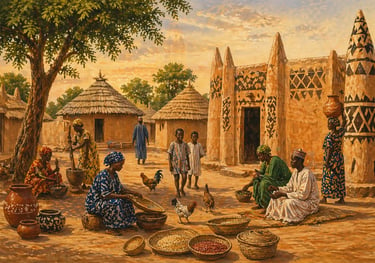
The physical layout of villages reflects practicality and culture. Homes are typically built from mud with thatched or metal roofs, arranged in family compounds. These compounds serve as living spaces, work areas, and social hubs. Open courtyards are common, providing space for cooking, resting, and hosting visitors.
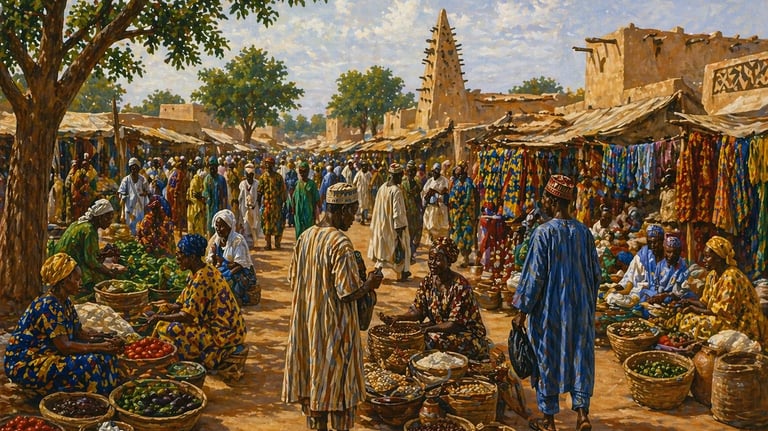
Markets play a vital role in village economies. Weekly market days bring together traders, farmers, and artisans from surrounding communities. These markets are vibrant spaces where goods are exchanged—food, textiles, livestock, and crafts—and where social connections are strengthened.
Cultural life is expressed through ceremonies, attire, and oral traditions. Weddings, naming ceremonies, and religious festivals are significant events marked by music, food, and traditional dress. Storytelling, proverbs, and local knowledge are passed down orally, preserving history and identity across generations.
Despite its traditional structure, village life is gradually evolving. Access to education, mobile technology, and improved transportation is introducing new opportunities and perspectives. However, these changes coexist with long-standing customs rather than replacing them entirely.
In essence, village life in Arewa is a balanced system built on interdependence, respect, and continuity. It offers a model of living where relationships are central, resources are shared, and culture is actively practiced in everyday life.
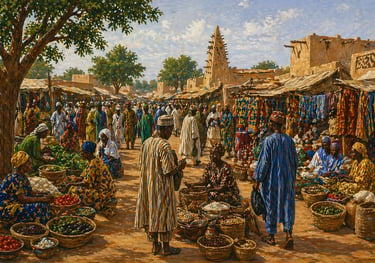
Arewa Commerce and Economy
Commerce in Arewa is both an economic system and a cultural institution, rooted in centuries of exchange across West Africa and beyond. Markets are not merely places of buying and selling; they are vibrant arenas of social interaction, information flow, and cultural expression. From rural weekly markets to historic urban trading centers, commerce has long shaped the identity and prosperity of Northern Nigeria.
Historically, Arewa occupied a strategic position in trans-Saharan trade networks linking West Africa to North Africa and the Mediterranean. Cities such as Kano and Katsina emerged as major commercial hubs, facilitating the exchange of goods like leather, textiles, grains, and later, kola nuts and livestock. These centers developed sophisticated trading systems, merchant classes, and craft specializations that continue to influence modern commerce.
At the village level, markets operate on a periodic basis—often every four or five days—creating a rotating system that connects multiple communities. On market days, otherwise quiet settlements transform into bustling spaces filled with traders, farmers, artisans, and buyers. Goods are displayed in open stalls or on mats, ranging from agricultural produce and livestock to handmade crafts, clothing, and household items. The atmosphere is dynamic, characterized by negotiation, movement, and social engagement.
Trade in Arewa is highly structured yet flexible. Bargaining is a fundamental aspect of transactions, reflecting both economic logic and social interaction. Trust and reputation are critical; long-standing relationships between buyers and sellers often determine pricing, credit access, and repeat business. Informal financial practices, including rotating savings and credit associations, support small-scale traders and sustain market activity.
Women play a central role in market commerce. They dominate segments such as food vending, grain trading, and processed goods, contributing significantly to household incomes and local economies. Their participation extends beyond economic activity to social networking, information exchange, and community cohesion within market spaces.
Artisanal production is closely tied to market systems. Crafts such as leatherwork, weaving, dyeing, pottery, and calabash decoration are produced for both local consumption and regional trade. These goods carry cultural value in addition to economic worth, often reflecting identity, status, and tradition.
Livestock trade is another defining feature of Arewa commerce, particularly in regions influenced by pastoral systems. Cattle, goats, and sheep are traded in dedicated sections of markets, linking pastoralists and settled communities in mutually beneficial exchange networks. This interaction underscores the interdependence of different economic lifestyles within the region.
In contemporary times, Arewa’s market systems are adapting to broader economic changes. Urbanization has expanded permanent markets and introduced modern retail structures, while transportation networks have increased the flow of goods across regions. Mobile technology and digital payments are gradually influencing trade practices, although traditional systems of trust and face-to-face negotiation remain dominant.
Despite these transformations, the essence of commerce in Arewa endures. Markets continue to function as lifelines of economic activity and as spaces where culture is lived and transmitted. They embody a balance between tradition and adaptation, sustaining livelihoods while preserving the social fabric that defines the region.
Ultimately, commerce in Arewa is not only about exchange of goods; it is about the exchange of relationships, values, and identity. It remains a powerful testament to the region’s historical depth and its capacity to evolve without losing its cultural core.