Arewa Art News
The leading digital platform for news, criticism, and market intelligence on art
Arewa Art News is a dedicated editorial platform documenting, analyzing, and amplifying the contemporary and traditional art ecosystem of Northern Nigeria. We provide timely reporting on exhibitions, fairs, auctions, institutions, artists, collectors, and cultural policy, while preserving the narratives that define the visual culture of Arewa.


Reframing Northern Nigeria’s Artistic Voice
Reframing Northern Nigeria’s Artistic Voice
For decades, the narrative of Nigerian contemporary art has been shaped largely by a narrow geographic lens. While the country’s global art visibility has grown, much of that recognition has remained concentrated in a few urban centers. Northern Nigeria, despite its deep cultural history and expanding community of contemporary artists, has often been positioned at the margins of this discourse. Reframing its artistic voice is therefore not simply an aesthetic exercise; it is a structural and intellectual necessity.
Northern Nigeria has never lacked artistic substance. From centuries-old traditions in textile, craft, and symbolism to a new generation of contemporary practitioners working across painting, mixed media, installation, and digital forms, the region offers a distinct visual language. What has been missing is a consistent platform for interpretation, documentation, and dissemination. Without these, artistic production exists, but its influence remains limited.
Reframing begins with visibility, but it must go beyond exposure. It requires a shift in how art from the region is understood and presented. Too often, Northern Nigerian art is interpreted through external frameworks that prioritize exoticism, tradition without evolution, or cultural reduction. A more accurate approach recognizes the region as a site of both continuity and transformation, where artists engage with identity, urbanization, memory, environment, and global exchange in ways that are both locally grounded and internationally relevant.
Equally important is the role of institutions. Galleries, curators, writers, and media platforms must actively participate in shaping a coherent narrative around Arewa art. This includes documenting exhibitions, building artist archives, producing critical writing, and facilitating dialogue within and beyond the region. Without institutional support, artistic voices remain isolated, and their contributions risk being undervalued or overlooked.
The market dimension cannot be ignored. Visibility and narrative are closely tied to value. When a region’s art is under-documented and under-theorized, it struggles to gain traction among serious collectors and institutions. Reframing the artistic voice of Northern Nigeria therefore also involves positioning it within a credible market structure, supported by provenance, valuation systems, and professional representation.
There is also a generational shift underway. Younger artists from Northern Nigeria are increasingly confident in their practice, more experimental in their methods, and more connected to global conversations. They are not waiting for validation; they are creating work that demands attention. What they require is an ecosystem that can match their ambition with structure, visibility, and critical engagement.
Media platforms have a central role to play in this transformation. By providing consistent coverage, thoughtful analysis, and a space for artists to articulate their perspectives, they help construct a shared narrative that strengthens identity and expands reach. In this sense, reframing is not about rewriting history, but about telling it more completely and more accurately.
Ultimately, reframing Northern Nigeria’s artistic voice is about recognition and positioning. It is about ensuring that the region is not seen as peripheral, but as integral to the broader story of Nigerian and African contemporary art. It is about moving from silence or misrepresentation to clarity, confidence, and influence.
The work has already begun. What remains is to sustain it with intention, structure, and commitment.
Art Archival in Arewa: Preserving Memory, Securing Legacy
Arewa Art News exists to fill a critical gap in Nigeria’s cultural media landscape. While Northern Nigeria has long produced powerful visual traditions and contemporary artistic voices, it has remained underrepresented in mainstream art journalism and market discourse. This platform is designed to change that. Through rigorous reporting, artist profiles, exhibition coverage, opinion essays, interviews, and market analysis, we create a credible and enduring home for the stories, ideas, and value systems shaping Arewa art.
Featured Story
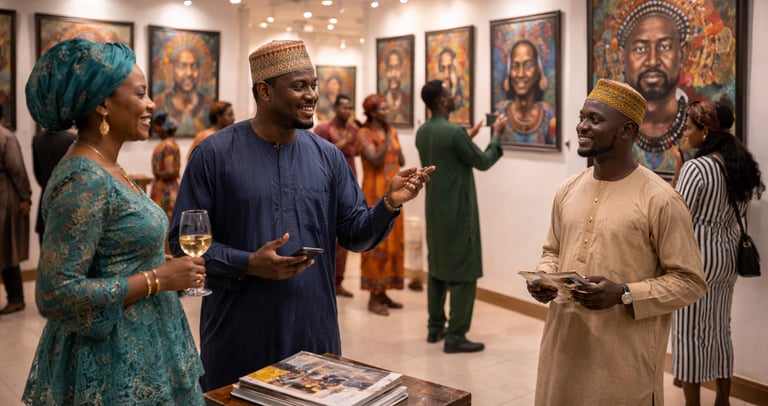
Art archival in Northern Nigeria remains one of the most critical yet underdeveloped components of the region’s creative ecosystem. While artistic production continues to grow in both quality and quantity, the systems required to preserve, organize, and transmit this body of work across generations are still largely absent. Without deliberate archival practices, the cultural, historical, and intellectual contributions of Arewa artists risk being fragmented, overlooked, or permanently lost.
Archiving is not merely about storage. It is a structured process of documentation, cataloguing, preservation, and interpretation. It involves recording artworks, artist biographies, exhibition histories, critical writings, and institutional activities in ways that make them accessible and verifiable over time. In more established art ecosystems, archives form the backbone of scholarship, valuation, curatorial work, and cultural policy. They provide continuity, allowing each generation to build upon the last.
In Arewa, much of this continuity is still informal. Artistic histories are often transmitted orally or exist in scattered personal records. Works are created, sold, and dispersed without systematic documentation. Exhibitions take place without proper records, and many significant artistic contributions remain undocumented beyond memory. This creates a fragile cultural landscape where even influential artists can disappear from formal recognition within a short period.
The implications are far-reaching. Without archives, it becomes difficult to establish provenance, assess value, or conduct meaningful research. Curators lack reliable references, collectors face uncertainty, and institutions struggle to build coherent collections. More importantly, the absence of archives limits the ability of Northern Nigeria to assert its rightful place within national and global art history.
However, the need for archival systems also presents a strategic opportunity. As the Arewa art scene gains visibility, there is a growing awareness of the importance of documentation and preservation. Artists are beginning to keep records of their work, while galleries and independent platforms are taking initial steps toward structured documentation. These efforts, though still limited, signal the beginning of a more intentional approach to archiving.
To move forward, a multi-layered strategy is required. Artists must adopt basic archival practices, including cataloguing their works, maintaining photographic records, and documenting exhibitions and sales. Galleries and curators need to implement standardized systems for record-keeping, including certificates of authenticity, exhibition catalogues, and digital databases. Academic institutions and cultural organizations should play a central role in building research archives and training professionals in art documentation and preservation.
Digital technology offers a particularly powerful tool for this transformation. Online archives, digital catalogues, and searchable databases can significantly reduce the barriers to documentation and access. When properly managed, these platforms can serve as living repositories that connect artists, researchers, collectors, and the public.
At a broader level, art archival is an act of cultural responsibility. It ensures that the stories, ideas, and identities expressed through art are not lost to time or misrepresentation. For Arewa, a region rich in history, symbolism, and evolving artistic language, archiving is essential to safeguarding its creative heritage while supporting future innovation.
Ultimately, the strength of any art ecosystem is measured not only by what it produces, but by what it preserves. For Northern Nigeria, building a culture of archival practice is not optional. It is foundational to recognition, credibility, and legacy.
Voices
What readers say about arewavista
Arewa Art News brings northern Nigerian art to life with stories that feel personal and insightful. It’s my go-to for fresh perspectives.
Amina Abdullahi Kallamu


Kano
The depth of coverage on artists and cultural events here is unmatched. It’s like having a front-row seat to Arewa’s vibrant art scene.


Emeka B
Kaduna
★★★★★
★★★★★
Stay Updated
Get fresh insights on Arewa art